
Are you Convinced That Two Plus Two Equals Four?
Be careful of your answer

By Rick Magder
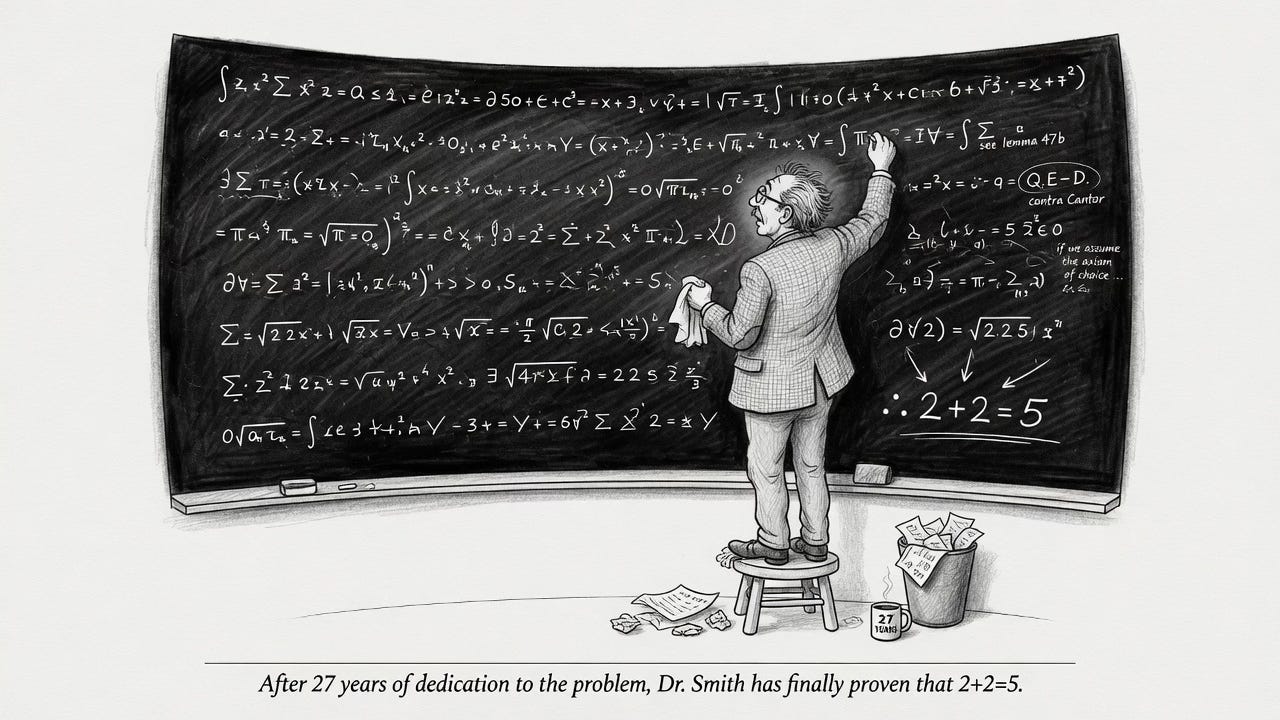
There's a long-running idea in mathematics about a perfect, imaginary book, not something you can actually open, but a mythical place where the most elegant mathematical proofs exist. So clean, so precise, that nothing could be removed and nothing needs to be added. Paul Erdős, one of the 20th century's most influential mathematicians, famously said that when a proof reaches that level of perfection, it comes "from The Book."
Recently, an AI newsletter reported that using GPT-5.4, mathematician Przemek Chojecki solved Erdős problem #1196, a 60-year-old elusive problem that had only seen partial progress. What struck mathematicians wasn't just that AI helped solve it, it was how it looked. The proof was short, direct, and elegantly simple. Not pages of complexity. Just clarity. And they recognized it immediately as "Book" worthy.
This reaction points to something deeper about how we experience truth. We tend to think truth is something complicated, something you have to fight about. And often that's true. The process is messy, confusing, full of wrong turns and partial answers. But every once in a while, after all that effort, something clicks. The noise drops out. The confusion disappears. Not because it was obvious all along, but because you're finally seeing it clearly. That moment has a feeling to it. I call it the exhale.
Why it’s hard to get there is because we like to think we're searching for truth, but most of the time we're actually searching for agreement. We gravitate toward voices that reinforce what we already believe, and that trains us to stop thinking critically. There are specific patterns that signal whether someone is genuinely seeking truth or just seeking your compliance, and they appear everywhere, across all sides, all ideologies, all media. Learning to spot them is one of the most important skills you can develop. The issue isn’t whether someone is biased. Everyone is. It’s unavoidable. It shapes how we see the world. The question is what you do with it. The conclusion is decided first. Then facts get selected, framed, or ignored to support it.
That’s persuasion dressed up as truth.
The red flags are consistent: When obvious questions aren't asked. When claims are made without evidence or evidence is cherry-picked to support a predetermined conclusion. When outrage is selective, when someone applies one standard to their side and a different standard to the other. When incentives are misaligned with truth, when the person benefits more from keeping you confused or engaged than from your understanding. We see it all the time: media personalities, news anchors, podcasters, influencers. It’s becoming so blatant. Ask yourself “are they really trying to get to the truth?”
There are people that have been my go-to news sources for years. It’s become increasingly difficult to continue watching them because I see:
Missing context
Weak counterarguments
Selective outrage
Certainty where there shouldn’t be any
What genuinely seeking truth looks like is different. There's an intellectual honesty to it. The person acknowledges the strongest version of opposing arguments. They admit uncertainty where it exists. They correct themselves when wrong. They apply the same standard to their side as to the other. None of this requires perfection. It requires honesty. That’s where you find truth.
Mathematicians solve problems it's simple: right or wrong. There's no ideology in calculus, no tribal affiliation in geometry. Yet a mathematician's highest aspiration is to arrive at something belonging in "The Book." What they're really chasing is something absolute. If you believe there is an ultimate source of truth, then truth itself isn't flexible. It isn't partisan. It isn't shaped by preference or tribal loyalty. It just is. And when you're willing to set aside your own biases, your own need to be right, your own side's preferred narrative, and actually look for it, something happens. You get clarity and calm. You get the exhale.
Last I checked, 2 + 2 does not equal 5. That's not opinion. That's not narrative. That's truth. The skill of critical thinking begins with the ability to read between the lines, to spot the patterns that signal genuine truth-seeking versus sophisticated persuasion. That's not a political skill. It's a life skill. It's how you navigate not just media, but relationships, career decisions, and your own mind.
Now you can exhale and enjoy the rest of your day.
Try this today: Start with what you consume. Pick a commentator, podcast, writer or outlet you usually agree with. Watch or read one piece carefully and look for three things:
What context is missing
Whether the strongest opposing argument is presented fairly
Whether the same standard is applied across both sides
Then flip it. Find one source you usually disagree with and do the same exercise.
Now bring it into your own life. In a conversation, decision, or disagreement, notice that moment when you feel that you’re right and they are wrong. Pause and ask:
What might I be missing
What would the other person say if I really listened
Are they genuinely open to hearing a different perspective
Am I being consistent, or just defending my side
Ask who is actually trying to honestly get it right. You or them or neither of you. You might at best agree to disagree but at least you will take the temperature in the room way down. That’s worth an exhale.
Summary: Truth doesn’t usually feel like winning. It feels like clarity. Like an exhale after confusion. The problem is we replace truth-seeking with agreement-seeking, in the media and in our own lives. The skill is learning to question your thinking in real time and read between the lines everywhere else. Because truth isn’t shaped by preference or loyalty. It just is. And the closer you get to it, the clearer everything becomes.